
HAIKU results – NZPS International Poetry Competition 2026

HAIKU JUDGE’S REPORT – GRAHAM BATES
Part of the privilege of being this year’s judge was that it gave me the opportunity to host an hour-long Zoom workshop called A Brief Guide to Writing Haiku Poetry where I drew attention to the spiritual and therapeutic nature of kigo. I then went on to emphasise the Japanese aesthetic principles of sabi and aware as a kind of compass for the subject matter that best suits haiku, with wabi emphasised more in the editing process, where the aim is to produce a seemingly effortless minimalism that makes the haiku utterable in one breath, giving it a sense of simplicity, surprise, and incompleteness. I also presented several ways in which the two parts of a haiku (fragment and phrase) may be juxtaposed for the purpose of achieving what I believe to be the main goal of any haiku: emotional resonance via concrete (sensory) foundations (and it can be especially pleasing to see haiku that feature senses other than the visual, or the typically agreed upon five).
When going through the initial phase of longlisting, I noticed many entries where the poets obviously didn’t have all of the targets mentioned above in their minds during their writing/editing process, and therefore, while they may have tried hard, didn’t quite know where the bullseye was. Once I had my longlist, I made my shortlist by looking for the kinds of haiku that, for me, did a better job of ‘taking me there’ with a strong, clear sense of actuality. Any haiku that I felt wasn’t yet the best version of itself, due to its structure, form, or having contained a tautology (and these can be subtle) didn’t make it to the shortlist. Haiku poetry has always been about capturing a sense of time and place, and I was especially on the lookout for haiku that weave together the natural and human in a simple yet profound way, as well as for very effective senryu that deal exclusively with human concerns, either in a comic or serious way.
Narrowing the shortlist down to an even shorter one, then choosing which ones would make my final list took me a long time and was certainly not easy, so if you find that your haiku didn’t make the list, believe me when I say that it doesn’t mean yours wasn’t commendable! For instance, there were many good haiku which featured the moon or the stars, but if I chose them all it would make for a repetitive list and possibly send a signal that the way to win is to enter as many of those as possible in the future. While my final choices are bound to reflect my own beliefs and taste at this stage in my personal haiku journey, I hope that they also embody the general values of Aotearoa haiku poetry generally.
My sincere thanks go to NZPS for inviting me to be this year’s judge, and especially to Kim Martins for helping me with the Zoom workshop, guiding me through the selection process, and doing all the admin behind the scenes that makes the whole contest possible.
I hope you all enjoy my selections, and that they inspire you in your own haiku practice
Ngā mihi,
Graham Bates
FIRST PRIZE
WANDA AMOS
OLD BAR (BIRIPI COUNTRY), NSW, AUSTRALIA
ANZAC sunrise …
a tūī’s song counterpoint
to the last post
***
Comment: For those who are unaware, The Last Post is a traditional bugle call that signifies the end of a soldier’s day. It is played by a lone bugler every year at dawn on April 25th to mark the beginning of the period of remembrance for Australian and New Zealand soldiers who fought together on the shores of Gallipoli on that day in 1915. ANZAC Day is mid-autumn, and in the first line we are told that it is not a rainy one, which means The Southern Cross may well be visible.
Tūī are a native bird of Aotearoa and have a wide vocal range, even producing sounds outside the range of human hearing. For this reason, they are said to sing in both physical and spiritual realms. They are even believed by Māori to have a link to the atua (gods) and to be spiritual guardians. Playing audio tracks of the The Last Post along with a lone tūī’s song helped me to imagine what the poet may have felt in the moment. It’s very likely they had an ancestor who died at Gallipoli or elsewhere in WWI, and that it’s a family tradition for them to attend the dawn service.
The use of the term ‘counterpoint’ is a surprising choice, and a pivotal one at that, as it means ‘to both complement and contrast in order to bring balance’ and while the poet has captured the simple charm of the moment, they also hint at a complex mix of emotions at play. I wondered if they were thinking of The Māori Contingent (which had a casualty rate of 88%), the Army Nurses, The Home Front, or even conscientious objectors such as Archibald Baxter. Of course, I also thought of the wars and conflicts going on today, as well as the general rise of nationalist politics worldwide. Kei wareware tātou. Lest we forget.
SECOND PRIZE
MARA GAJIC
VIENNA, AUSTRIA
funeral bouquet—
the sound of water
shattering
Comment: Ashes have just been scattered into a body of water, and then a funeral bouquet is thrown, making a sound that is both literally and figuratively shattering. The poet alludes to Bashō’s most well-known haiku, though this time the ‘sound of water’ has an awfully cold sense of finality to it.
***
THIRD PRIZE
DEBBIE STRANGE
WINNIPEG, MANITOBA, CANADA
of Candlemas bells . . .
final chemo
Comment: Commonly known as snowdrops, these bulbs got their nickname through their Northern Hemisphere bloom time aligning with the Christian festival of Candlemas. They tell us that it is late winter or early spring, and are associated with purification, light and hope, which in this haiku is also the hope of a successful treatment and recovery. The silence could be an eerie one, but it also brought to mind Thomas Merton’s exploration of the concept of silence as the ultimate form of prayer.
***
FOURTH PRIZE
CRISTIAN MATEI
BUCHAREST, ROMANIA
scent of quinces—
the refugee’s voice
falters
Comment: Fruit from the quince tree comes in mid-autumn but is inedible when raw. The slow-cooking process to make it sweet and vibrant is akin to that of the refugee adapting to their new life.
When reading this haiku, I picture an older refugee in their home catching the scent of quinces cooking in preparation for some traditional recipe from their homeland; their voice faltering, and tears welling. The em-dash helps to give us the feeling of the scent cutting through the refugee’s talk, straight to the heart.
***
FIFTH PRIZE
OWEN BULLOCK
CANBERRA (NGUNNAWAL AND NGAMBRI COUNTRY), ACT, AUSTRALIA
nightsong
the river through
the river stones
Comment: There’s a very subtle double entendre going on here. The daytime river makes its way ‘through’ the stones, which could represent everyone’s daily struggle with its twists and turns, but on this warm summer night, where the wind has died down, the river sings ‘through’ those very same stones of an underlying interconnectedness
HIGHLY COMMENDED (IN NO PARTICULAR ORDER)
a murmuration
of wild poppies
Sue Courtney, Orewa, New Zealand
The season is spring and these godwits have once again completed their long, arduous journey from Alaska. The poppy is associated with both eternal rest and passionate sacrifice. Using a collective noun usually reserved for birds to describe the movement of the poppies is a brilliant choice!
***
soap bubbles—
my dog sniffing the rainbow
away
Mara Gajic, Vienna Austria
The first two lines of this haiku are so delightful, but with the skillful use of enjambment, the sense of aware really hits home in the last line!
***
embers . . .
I don’t want
to leave
Owen Bullock, Canberra (Ngunnawal and Ngambri country), ACT, Australia
Late summer. Sitting by a campfire alone, feeling the diminishing warmth of the embers, grey-white on the outside but glowing within like the youthful self that feels like it was just here yesterday. The use of the subjective ‘I’ as pronoun is so apt, as we all have an ego that clings and a spirit that does not want to ‘go gentle into that good night.’
***
rock salt
a stream from old snow
when you left me
Alan Peat, Stoke-on-Trent, England
When you use rock salt on old, compacted snow it mixes with the water in the snow to form a saltwater brine, lowering the freezing point of the water and causing it to melt. Such a brilliant metaphor for the grieving process!
***
dawning the eaves pink icicles of light
Simon Hanson, Allendale East (Bunganditj (Boandik) people), South Australia
The way the poet turns the noun ‘dawn’ into the verb ‘dawning’ gives this wonderful phenomenon the sense of unfolding before our eyes. It is as if, at the same time, something profound is dawning within. The monoku form is perfect for the subject matter and with the kire able to be placed before or after the word ‘pink’ we really get a sense of the pink light’s all-at-once-ness.
***
missing her
moonlight
through trees
Lev Hart, Calgary, Alberta, Canada
The verb ‘missing’ has a double entendre, as does the pronoun ‘her’, opening up a variety of interpretations. I pictured the poet out walking among trees on a moonlit night while thinking of a lost loved one, or perhaps walking on a moonless/overcast night. Then I thought of a grave that the ‘moonlight through trees’ is literally missing. After that, I thought of ‘her’ as referring to Mother Nature, which led me to think of someone far away from home pining for their natural landscape while maybe missing their partner or spouse.
***
melting ice pond
the moon loses
its surplus
Cezar Ciobica, Botoșani, Romania
Winter’s end. I feel that this is a brilliant metaphor for forgiveness, acceptance, self-love, falling in love, or even the therapeutic benefits of being vulnerable and opening up to another.
***
concert
the sleeper joins
a standing ovation
Nola Borrell, Te Awa Kairangi ki Tai Lower Hutt, New Zealand
Well, I just love the humour and insight of this one. Comic senryu at its best!
***
braided river
the wind
takes my words
Jane Myhill, Ōtautahi Christchurch
The way the wind takes the poet’s words is a brilliant comparison to how two channels of the river cross, and also for how people interweave into the natural landscape. Perhaps this is a person grieving the loss of a loved one, or a person simply overcome by the beauty and mana of the sight of the braided river and how it speaks to the journey of life, both as lived on the ground and as seen from above.

COMMENDED (IN NO PARTICULAR ORDER)
light capture
the red cyclamen rises
out of tired leaves
Nora Borrell, Te Awa Kairangi ki Tai Lower Hutt, New Zealand
The cyclamen’s tired leaves lead us to think that this haiku is situated around the end of spring, when so many other plants’ blossoms are flourishing but the cyclamen is quickly approaching its natural period of dormancy. It speaks to me of a tired, ageing person grateful for waking up to a new day, or longing to recapture the light of youth and love. One also pictures an ageing poet trying to ‘capture’ that timeless haiku they feel is still within them, and considering how this haiku could easily be a Buddhist mantra, I would say they succeeded!
***
reflecting pond a swan preening
Scott Mason, New York, USA
The swan is a kigo for winter and signifies the harshness of the season as well as the stillness of cold or frozen waters. The monoku form feels perfect for the image of a reflecting pond, and the stark beauty here oozes with sabi, wabi and aware.
***
the chimes of korimako
enter my dream
Sue Courtney, Orewa, New Zealand
I’m sure anyone would love to have the bellbird’s dreamy song gently coax them from a dream on an otherwise cold winter’s morning.
***
saltwater breeze
ripples
in a broken shell
Sue Courtney, Orewa, New Zealand
One gets the sense of someone in the grieving state, where they feel so much like a broken shell that even the gentlest breeze may bring tears. Or it could simply be the fleeting delight of noticing this tiny natural phenomenon. Also, I felt the shape of the haiku was very suited to its subject matter.
***
spine fracture
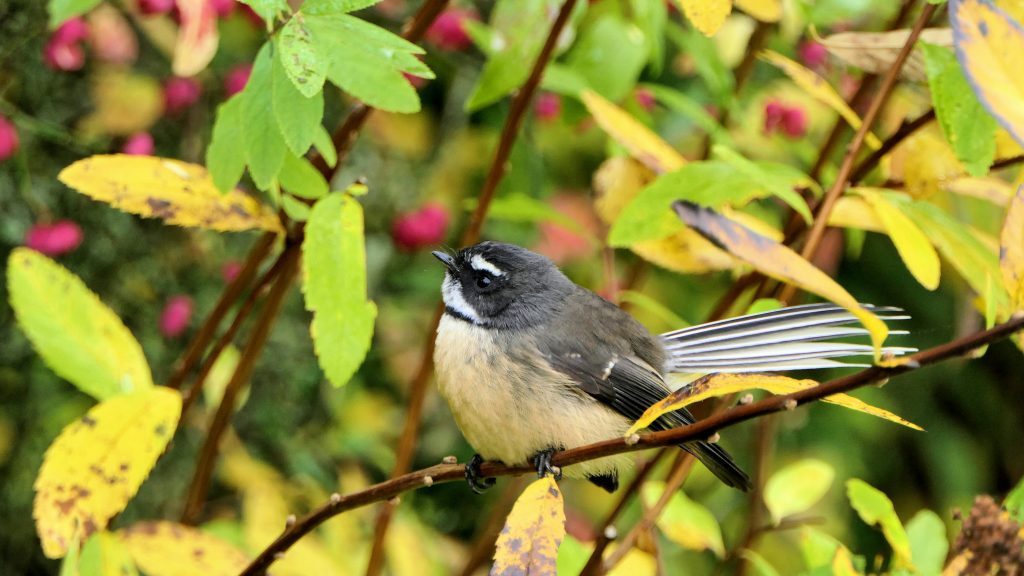
the pīwakawaka swirls
and swoops
Nora Borrell, Te Awa Kairangi ki Tai Lower Hutt, New Zealand
I have never had a spine fracture but I’m sure the way the injury refers pain is very akin to the swirling and swooping of the fantail, which is known for its cheekiness, and seems to mock the poet, but given how the pīwakawaka can thrive in an urban environment, it may also speak to resilience and adaptability.
***
a left-out tea cloth
crackles with rime
Marietta McGregor, Stirling (Ngunnawal country) ACT, Australia
I found the onomatopoeia in this haiku so pleasing, and the very humble, homely image abounds with that austere beauty associated with wabi.
***
everyone in pink …
her last wish to show a life
well lived
Wanda Amos, Old Bar (Biripi country), NSW, Australia
I really enjoyed imagining a funeral with everyone wearing pink instead of black and I’m sure it put the emphasis on celebrating her life, making it all the more memorable (especially as it inspired this haiku).
***
bleached by the sun . . .
grandfather’s hands
Debbie Strange, Manitoba, Canada
Antlers are shed in late winter and early spring, but these must have spent a long time out in the sun to turn chalky white, like the grandfather’s arthritic hands with poor circulation, whose fingers struggle to fully open. Of course, antlers, in deer, are associated with masculinity, but these hands cannot be shed and regrown, though they may at times feel as useless as those shed antlers.
***
fungi blossoms
on the stillborn fawn
summer’s end
Farah Ali, Brighton, England
Summer is typically associated with youth, but this fawn was deprived even of that. One can’t help but wonder if this image resonates with a traumatic event in the poet’s own past. I love how the contrast of fungi ‘blossoming’ on the dead fawn allows this haiku to transcend our categories of good and bad by simply doing as nature does and showing us reality as it is.
***
butterflies jink
over fallen branches
the fiery sun
Farah Ali, Brighton, England
This is a lovely summer image, but one that has within it the threat of those branches acting as kindling for a wildfire. Very pertinent to the times we live in!

NEW ZEALAND POETRY SOCIETY
PO BOX 5283
WELLINGTON 6140
NEW ZEALAND
NEW ZEALAND POETRY SOCIETY
PO BOX 5283
WELLINGTON 6140
NEW ZEALAND