
LYNN JENNER
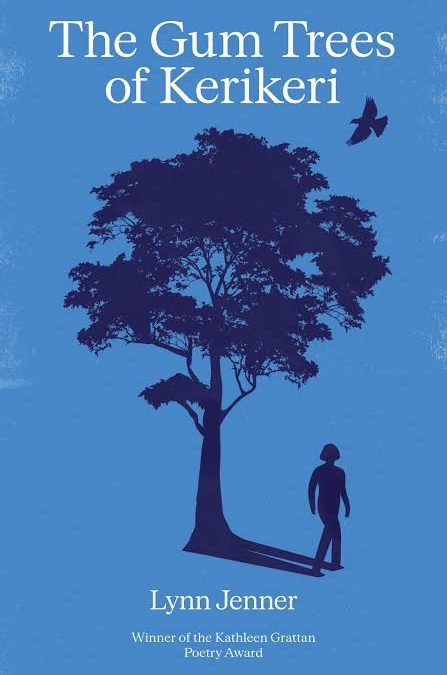
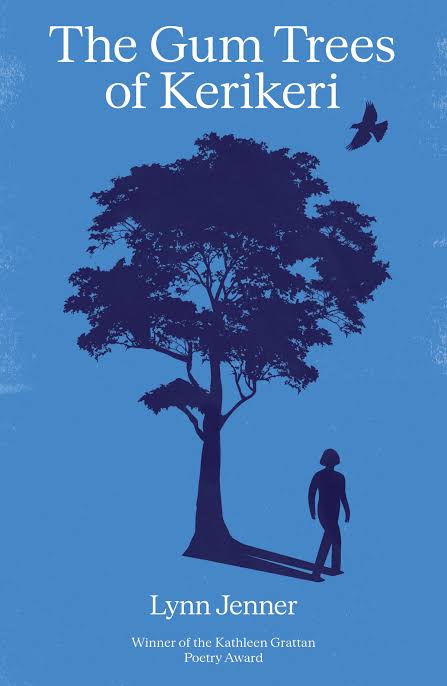
The Gum Trees of Kerikeri
(Otago University Press, 2026).
ISBN 9781991348180.
RRP: $30. 64 pp.
I was shocked by news footage from Ukraine and Gaza a few years ago. Recurring scenes of rubble and destruction reminded me of Peter McIntrye’s monochrome paintings of the 1944 Battle of Cassino. I have been to Cassino where my father fought. I have walked amongst the graves of men and boys buried three deep; I have pushed ceramic poppies into the earth beside rows of white headstones. I recall that jarring sense of shock but now feel a constant gloom, so routine have the horrors become. I look to my garden where fat caterpillars wait patiently for the miracle of metamorphosis, quince glow golden in equinoctial sun, persimmon slowly ripen. The people of the Far North are less partial to persimmon than to the other fruits they grow and share, Lynn Jenner tells
us. Not a gardener herself, although at times wishing she was, in order, I suspect, to have the at her disposal, Jenner accepts the gifts of fruit she sometimes thinks she has done nothing to deserve. With this, she gives to us, her readers, the gift of human kindness.
The Gum Trees of Kerikeri is not a doomsday book but it asks the hard questions. Is this the age of the death of the planet? Do you see deliverance and redemption anywhere? Is this the Promised Land? And most chillingly, given that it was written before the current war in the Middle East, are we there yet? These questions are framed in reflections around the artist and writer who posed them: Colin McCahon and Anne Tyler, and around the philosophy of Zhou Zuoren. Jenner tells us Ursula Le Guin searched near the end of her life ‘for a way to resist the unfolding political and environmental catastrophes of these days.’ This quotation perhaps summarises the book’s raison d’etre. Jenner
responds by relaying Le Guin’s suggestion to follow ‘Lao Tzu’s “way of water” in order to counter aggression without being subsumed in war’ then walks the aptly named Fair Weather Loop Track. After crossing a stream, the river’s position confounds her sense of direction. It has proved a worthy resistance. The river’s twists and turns, pools and wildlife focused attention on the natural world’s beauty and mystery. So you see, this is not a pessimistic book. It is a gentle journey of enquiry in a life filled with everyday joy and confusion. Each poem feels satisfying yet curious: a small offering of humanity with a grounding effect at a time of crisis.
There are 56 prose poems, the longest of which is a page in length, so it is a physically slight book. There are no sections, chapters or titles. The poems are simply numbered. This lack of headings to guide the reader works to focus attention. Reading each poem is like walking a new bush track with a sense of impending surprise. I found myself asking, how is this going to end?
The poems begin by portraying life in a small, northern town. They celebrate the small things that unite a community, such as a friendly wave to a passing motorist. The tone is unemotional and matter-of-fact, yet the prosaic language contains metaphor and playfulness. A tour group from a cruise ship is compared to a line of SpaceX satellites, gum leaves are fabric and feather. Recurring motifs and images create an organic whole linking poems about disparate things: for instance, white space in Colin McCahon’s art and in a TV crime series.
We learn that the gum trees of the title were planted to provide shelter for livestock by a farmer who laments not being patient enough to have planted slow-growing natives. The poet has ‘mixed feelings’ about the exotic trees. She mourns the loss of other gum trees felled for firewood, which she buys. She describes a farmer on Country Calendar who venerates a single remaining kahikatea on a sheep farm he has planted in pine trees. Such portrayals showing the complexity of ecological change are modulated by references from art and literature that reflect on the value of trees across time and place, leaving the reader to ponder these associations. Other poems offer a similarly slant take on colonisation by reflecting on plaques and statues that are seen but which serve to reveal what is hidden.
The poems’ speaker, who I have every reason to believe is a true and faithful rendition of the poet herself and not a persona, spends her days walking the many rivers and bush tracks of her local area, going to yoga classes, protesting for Palestine, watching detective shows. The focus of these poems which make up nearly half of the collection is connection to place, people and the natural world that surrounds her. The poet is thoughtful, unsure about how to deal with the world’s political and climatic problems but trying to live a good life with ‘dark knowledge.’
There is a shift just before the half-way mark at poem 25 when talk of ‘a big war coming and capitalism in chaos’ (such prescience) disrupts the quotidian narratives. Jenner reflects on this possibility with matter-of-factness and empathy, saying she ‘always thought it would be a good thing but it’s costing people their jobs and makes our savings shrink.’ Political but practical. She likes to ‘walk up hills and watch what the birds are doing.’ But even looking to nature has its fishhooks. The so-called natural world is filled with violence and catastrophe: paint marks trees ready for harvest, traps catch introduced predators, and: ‘A hawk flies her usual beat from east to west looking for
anything small and soft and undefended.’
Poem 26 continues the shift away from the everyday to concern about the health of the planet. Here, ‘you,’ an unnamed person who lives with the poet, hopes for the best, replying yes to the question: would you have a baby now? Jenner is not convinced, stuck, she says, between ‘optimism and insouciance,’ unsure whether to look to science, love or to escape into a television series marathon. ‘Kitch now has a certain high-brow appeal and offers its own form of comfort,’ she writes. In poem 29, she compares her relationship with the way they keep a good but old vacuum cleaner ‘despite
certain inconveniences’, which I found very funny.
Along with humour hand-in-hand with weighty questions about the future of humanity, there are poems that tend to a belief in the whimsical or at least to the prospect of knowledge outside Western science: the power of St Francis, comfort in a star falling on the right rather than the left, bathing in moonlight. These possibilities perhaps reveal how we create optimism when there is little else that will surely work against the world’s cruelties. Here is poem 51 in full:
After 10 days of rain the sun is out; light and warmth feel
like a great power for good. I see six doves pecking in the
grass. I think of Noah and the dove with the twig in its
beak. And now, with the sun on my face, I think these
six doves on the lawn in Kerikeri might be an omen of
peace somewhere peace is needed. Sun and doves against
monsters and tanks.
The Gum Trees of Kerikeri is Jenner’s second book of poetry and winner of the 2025 Kathleen Grattan Poetry Award. It is a book for our times, not because it offers hope but because it validates uncertainty. It asks the big questions without finding answers. It celebrates enjoyment of the things which give us comfort and which we can control at a time when there seems little we can be reassured by from those who are in control.
And how does it end? With the sweet taste of fruit of course!
Janet Newman
Bio
Janet Newman lives in Horowhenua. She is an editor of Koe: An Aotearoa ecopoetry
anthology (OUP, 2024). Her collection, Unseasoned Campaigner (OUP, 2021), won
the 2022 NZSA Heritage Book Award for Poetry.