
Ed. A. Jansen, J. Begg, L. Carey, R. de Jong, W. Hollis, J. Lamb, R. Tahana-Dawson
Potluck: poems about food
(Landing Press, 2025).
ISBN 9780473759292.
RRP $25.00. 222pp.
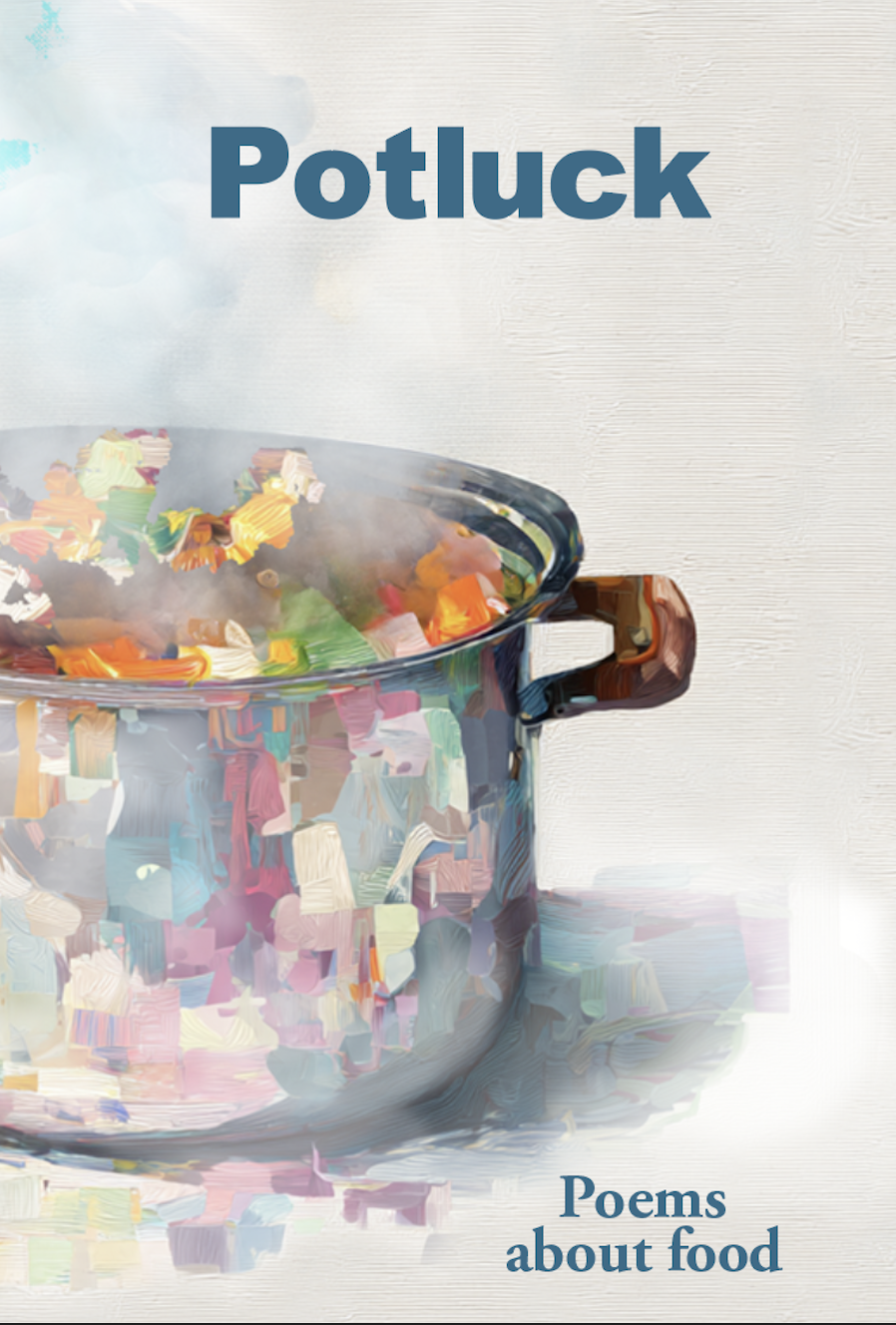
The newest offering from Landing Press is a collection of poems about food. Poems about food are, of course, not only about food. The subheaders offer hints at what to look for – for example, “Something to grow”, “Something to chew on”, “Something to savour” and “Something to finish with”, the last a poem by Vaughan Rapatahana. Each section takes us into recipes, bites, tastes – and the lives of the poets, with poet notes appearing on each page. The introduction notes that food ‘connects us with culture, history, memory, rituals, celebrations, agriculture, foraging, fishing…’ but also things like hunger, disorder, chemical additives, suggesting this is less comfort food than food for thought.
The book opens with “Pancakes” by Etienne Wain, a poem that comes from time spent with the poet’s grandmother during a family visit in Melaka. It offers a glimpse into family life, and change that comes when the poet’s grandmother cannot cook anymore – togetherness now found in eating papaya.
The ways food connects is a key element in many of these poems, and in that connection there is often quiet beauty. “E kai” by Sonya Kaire Judson is about the writer’s Nana’s banana cake as well as about wellbeing and much more, with a line in the middle that shines: ‘Red,’ she would say, ‘Your hair looks beautiful in the firelight.’ (“E kai”). Many of these poems are about generational gifts, things passed on, ways of carrying the past. Sometimes these things are suggested by a jaunty recipe for Victorian sponge cake (Jane Bloomfield), or by careful listing of recipe items. ‘Each ingredient holds a memory, a story, a piece of my family history,’ writes Hannah Phillips in “All in one dish”.
Sometimes generations open a poem, like these lines from “Achchi” by Githara Gunawardena:
My mother and I were fed by her mother,
Conjuring her mother’s woodsmoke
From a rushing Kawashi gas cooker
(“Achchi”)
And speaking of generations, here we have work by both very young and experienced poets. A haibun by 89-year-old John Ewen takes us to early 20th-century Blackball miners, while two poems nestle on facing pages with unexpected observations of poodles and cheetahs, written by Leah Hong, age 7, and Claire Bai, age 11 – and another two poems take on Brussels sprouts, these by 10-year old poets Rahi Key and Emily Jade Barrington.
Recipes and how-to poems abound. In Gabrielle Huria’s “Pāwhara eels at Pokuku”, we are guided through seasons and steps to food gathering, while Renee Liang delivers a different kind of instruction in “Energy recipe”. Laurice Gilbert’s “The dietician advised me to” is a tale of choice, agency and rebellion, and Eleazar Kener’s “Let’s not pretend” is a series of “5 minute depression meals”. On the other side of depression is good feeling: 12-year-old Claudia Anderson delivers “A recipe for peace”; Éimhín O’Shea’s “I am making you soup because I love you” is a recipe for friendship; the poem quoted on the back cover is Michele Powles’ “Hope cake” and Jenny Clay notes the importance of paying attention to small moments in “A wedding gift”:
just remember to turn
the pikelets
as the bubbles
start to burst
on the surface
(“A wedding gift”)
Humour is also here, from David Eggleton’s “Jamie Oliver’s TV dinner” (‘Never eat anything that just walked in and sat down in the kitchen’) to Ziu Tua’s “Yummy turtle guts” and Kate Butcher’s “How to improve school lunches”. The mix of humour with real-life difficulty goes down well when you’re writing about grief lasagna, as Sophia Henderson does. Sometimes meals are presented in vivid horror: Lin Youssef’s “Bamya” is described by the Syrian poet as a ‘classic dish adored by adults and dreaded by kids’. Susan Jacobs’ “Snails for dinner” had me cheering for the snail, choking on the indifference and siding with the poet who has now turned vegetarian.
Some poems demonstrate the importance of form. Take the shape poem “Rice” by Preeta Menon, which, like the food itself, is plain and of substance:
A
grain
of rice
is shaped
like a bullet
the bullet feeds
graves; the grain
of rice feeds
fields and
lives
(“Rice”)
Robin Peace’s “What lemons and oranges prove about Israel’s occupation” is a found poem, based on a 2024 article in The Washington Post, and shows careful curating of the article’s contents to bring it to its form on the page. When the poems are personal-political, they are particularly poignant. Erin Donohue’s “Hunger” takes us into a world of need, personal and historical-political, examining death and starvation in 16 layers. M.M.’s “Madleen” references the vessel raided by Israeli soldiers last year in June as it was delivering aid to Palestinians in Gaza, and the story of the boat’s name (in the author note), honouring Madleen Kulah, the first and only fisherwoman in Gaza, gives power to the poem.
Meanwhile, Manjit Grewal’s “Saturday morning at St Peter’s” is noticeable for the collective and meaningful ‘we’. The ‘we’ voice is strong in several poems, in fact: M.A.’s “Having, not having” reflects on a family’s personal struggle, arriving from Syria and not finding the land of plenty, while the ‘we’ suggests many who share this experience. Nikeel Kumar’s “What we know” has simple structure and form, yet the burden of what is known and not known strikes a deep chord by the end (she is another young writer, a Year 11 student who arrived in Aotearoa from Fiji in 2023).
There are quite a few poems for and about Palestine, about people facing difficulty, about people who wish to do more. Trish McBride’s “Difference” reflects a personal and spiritual search for justice that many are feeling these days. This collection is a view to our urgent times; a collection about food is, necessarily, about the collective need to survive.
Others pay close attention to rhythm and sound – this is, after all, a poetry book. Take Rebecca Ball’s “Midwinter Christmas”, which opens ‘winter hangs in the spokes of a spiderweb’ (“Midwinter Christmas”) and continues a delicate threading of words and images to the last note of light. Harry Ricketts’ “Survivor’s fridge” offers a listing of things on the cool shelves but holds together with tight spacing and careful placement, leading to the punch of the last line. While Ricketts writes of losing his wife, Michael Hall writes of his mother’s Alzheimer’s in two poems that sit on facing pages, delicate in their arrangement, ‘the potatoes thock / unquietly moiling’ (“Left on the stove”) on the left, a chopping board’s ‘strange hieroglyphs’ (“Mum’s chopping board”) on the right. These, too, are survival poems.
Our lives are written in poems. Michelle Zhao’s “Pizza, across the world” is the story of a long marriage. Kerry Dalton’s “First food” speaks for the early (and silent) stages of nurturing life. And “When I leave here…” imagines a first meal after confinement, penned by a man in Unit 9, Te Whare Manaakitanga, at Rimutaka Prison: ‘I will use that first meal to share with them/what it means to be back in their lives’ (“When I leave here…”).
The personal narratives are aplenty: Diane Brown’s tally of giving thanks (or not), Kirsten Warner’s conversation with the egg man, Janice Marriott’s observations of citrus. Also Apirana Taylor’s planting of kūmara in the aptly named “e tipu”; here the lines cascade down the page, glide us into the sensation of earth, taking us deep into generational connection with the soil:
when i plant kūmara i feel
something strong and deep
as i furrow the rich mounded
earth with my forefinger
and settle the tender
sensitive shoots to bed
row upon row i tuck
them in puku down
lay them to sleep
beneath a blanket
of earth, a sense of
another time over-
comes me, when the
kuia planted the shoots
ngā tipu, it was known their fingers were wise and gentle
(“e tipu”)
Of course, some poems just make us hungry, laying the table with the varied foods on offer in Aotearoa: Rangi Moanaroa’s “Celebratory food, marae food”; Jian Zu’s “The Lunar New Year feast”; Emily Luisetti’s “Lemon meringue pie”. It’s also worth noting poems that include languages besides English, serving up more richness. Majed Burhan’s poem in Arabic; Jian Lu’s poem in Mandarin: yes – more, please.
The book opens with a whakatauki, and it’s a good place to end here:
Nāu te rourou nāku te rourou
ka ora ai te Kaupapa
Your basket, my basket
Together will sustain us
Michelle Elvy
Bio
Michelle Elvy is a writer, editor and creative writing teacher in Ōtepoti Dunedin. She edits at Flash Frontier and At the Bay | I te Kokoru. Her books include the everrumble and the other side of better and the forthcoming ocean sky marble eye. In 2025 her poetry was shortlisted in the Kathleen Grattan Poetry Award, and she held the Riddell Residency in Oturehua and the Auckland Regional Parks Residency in Huia. Her poetry-art exhibit The Wild Edge featured at the Arataki Visitor Centre Jan–Mar 2026. michelleelvy.com